


26/07/2026
One of the most common questions among Japanese learners is how many Kanji characters are there and whether mastering all of them is necessary to communicate fluently. In reality, the total number of Kanji is enormous, but only a relatively small portion is used in everyday life. In this article, ANKOI will explain how many Kanji characters are officially used in modern Japanese, how many Kanji you need for each JLPT level, whether learning every Kanji is necessary, and practical strategies to study Kanji more efficiently.

How many Kanji characters are there in Japanese? Latest 2026 update
How many Kanji characters are there in Japanese?
If you search for how many Kanji characters are there, you will find different answers such as 2,136, more than 50,000, or even tens of thousands. This often confuses beginners and makes it difficult to determine which figure is correct.
In reality, all of these numbers are correct, but they refer to different classifications. If you count every Chinese character that has ever appeared throughout history, the total number of Kanji is extremely large. However, when considering the modern education system and actual usage, Japanese people mainly use a standard set of commonly used Kanji. Therefore, instead of worrying about how many Kanji characters there are, it is more important to understand each category and build a study plan that matches your learning goals.
Total number of Kanji characters ever recorded
According to major Kanji dictionaries, more than 50,000 Kanji characters have been recorded throughout history. This figure includes ancient characters, rare characters, specialized terminology, and many historical variants. That is why searches for how many Kanji characters are there often produce different numbers. However, the vast majority of these Kanji are rarely used in modern life. Even native Japanese speakers do not use all of them in their studies, work, or daily communication.
For Japanese learners, the goal is not to memorize all 50,000+ characters. Instead, you should focus on the Kanji that appear most frequently, including those found in:
- Textbooks
- Newspapers
- Government and administrative documents
- Public signs and general reading materials
- JLPT examinations
In other words, the total number of Kanji is mainly of statistical significance. Your learning goal should be to master the Kanji that are actually useful rather than trying to learn every Kanji ever created.
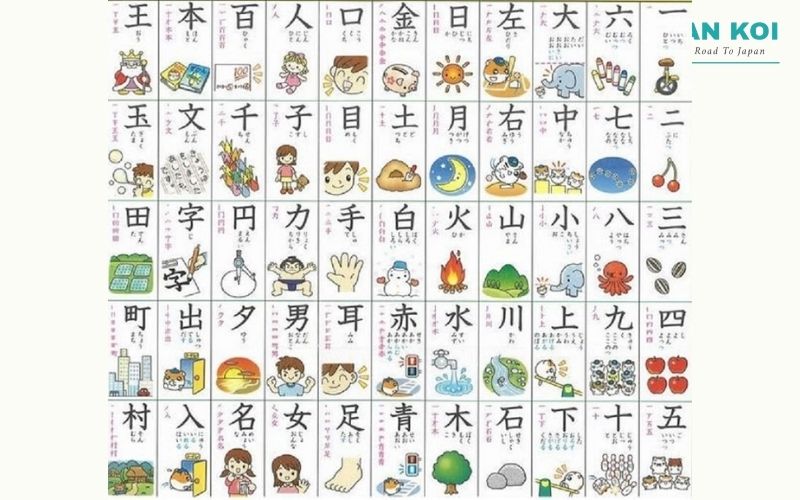
How many Kanji characters are there in Japanese?
2,136 common Jōyō Kanji characters
When discussing how many Kanji characters you need to learn, the most important number is 2,136 Jōyō Kanji (常用漢字). These are the officially designated Kanji issued by Japan’s Ministry of Education and are consistently used in schools, newspapers, publications, and official documents.
Among these 2,136 characters, approximately 1,026 Kyōiku Kanji are taught during elementary school, while the remaining characters are learned throughout junior high and high school. This step-by-step approach enables Japanese students to gradually build the Kanji knowledge needed for both academic study and everyday life.
|
Kanji group |
Quantity |
|
Kyōiku Kanji (Elementary School) |
1.026 |
|
Kanji is studied further in middle and high school. |
1.110 |
|
Total Jōyō Kanji |
2.136 |
If your goal is communication, reading comprehension, or passing the JLPT exam, mastering the Jōyō Kanji group is sufficient for effective use of Japanese. This is also the most practical answer to the question how many Kanji characters are there? we need to learn.
Are the 214 radicals the same as Kanji characters?
A common misconception among beginners is that the 214 radicals are the same as 214 Kanji characters. In reality, radicals and Kanji are two different concepts.A radical is a component used to form many Kanji characters. Radicals help classify, look up, and memorize Kanji more efficiently.
|
Radical |
Meaning |
Example Kanji |
|
木 |
Tree |
林、森、校 |
|
氵 |
Water |
海、河、酒 |
|
亻 |
Person |
休、体、住 |
Learning radicals does not mean learning all Kanji, but it provides an important foundation. By understanding the meaning of each radical, you can often infer the meaning of unfamiliar Kanji and remember them more easily.
Therefore, if you are researching how many Kanji characters there are, remember that the 214 radicals are simply the building blocks of thousands of Kanji – not the complete Kanji writing system itself.
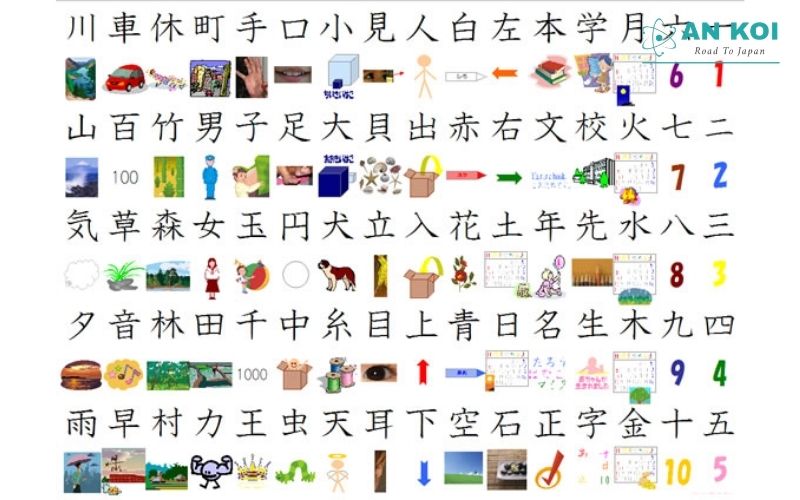
Have Are the 214 radicals the same as Kanji characters?
Is it necessary to learn all of the Kanji characters?
The answer is No. Although more than 50,000 Kanji characters have been recorded throughout history, modern Japanese primarily uses the 2,136 Jōyō Kanji in education, newspapers, and official documents. The remaining characters are mostly ancient, uncommon, or limited to specialized fields.Therefore, Japanese learners do not need to memorize every Kanji. Instead, you should focus on the commonly used Kanji that match your learning objectives.
Depending on your goals, the recommended number of Kanji to study varies:
|
Target |
Number of Kanji you should learn |
|
Travel to Japan |
100-300 |
|
JLPT N5 |
80-100 |
|
JLPT N4 |
Approximately 300 |
|
JLPT N3 |
Approximately 650 |
|
JLPT N2 |
Approximately 1,000 |
|
JLPT N1 |
Approximately 2,000 |
Rather than chasing numbers, prioritize the Kanji that frequently appear in textbooks, vocabulary lists, and JLPT exams. For example, if your goal is to pass the JLPT N5, mastering 80–100 Kanji is far more effective than trying to memorize hundreds of rarely used characters. Once you have built a solid foundation, you can gradually expand your Kanji knowledge level by level. This is also the learning path recommended by many teachers and ANKOI, as it saves time, reduces pressure, and improves long-term retention.
How many Kanji characters do I need to learn for the N5 exam?
If your goal is to pass the JLPT N5, the number of Kanji you need to learn is relatively small. Although the JLPT does not officially specify the number of Kanji required for each level, textbooks such as Minna no Nihongo, Genki, and analyses of past JLPT exams suggest that learners should master approximately 80–100 Kanji. These are all commonly used Kanji that frequently appear in standard Kanji lists and are used in basic everyday communication.
The N5 Kanji mainly cover familiar topics such as:
- Numbers: 一、二、三、十…
- Time: 日、月、年、時…
- Family: 父、母、兄、姉…
- School: 学、校、先、生…
- Places: 山、川、駅、町…
- Basic verbs: 行、来、見、食、飲…
Instead of trying to learn every Kanji, focus on the characters that appear in your textbooks and the JLPT N5 exam. By studying 5–10 Kanji per day, while practicing reading, writing, and reviewing regularly, most learners can complete the N5 Kanji set in one to two months. This also provides a solid foundation for progressing to the N4 and N3 levels.
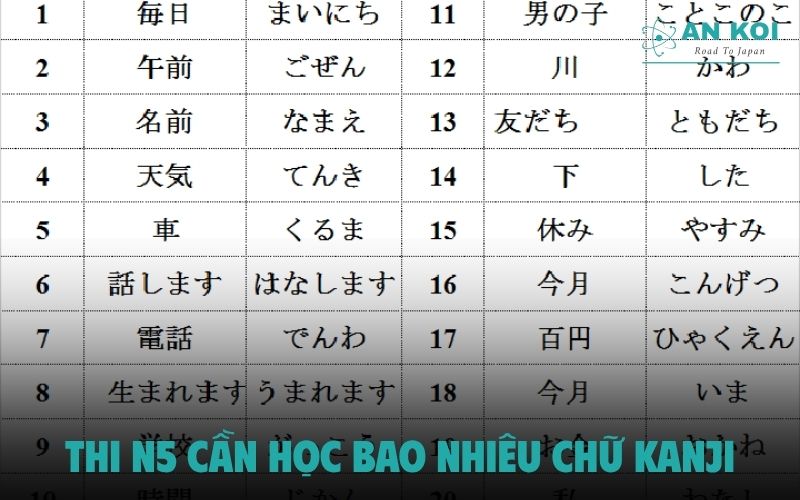
How many Kanji characters there are in Japanese do I need to learn for the N5 exam?
Effective ways to learn Kanji for beginners
To learn Kanji effectively, you should build a learning path from easy to difficult and maintain regular review. Instead of learning too much in a short time, combine reading, writing, and using Kanji in real-life contexts to remember them longer.
Here are some effective methods for learning Kanji:
- Learn by radicals:Understanding the meaning of radicals helps to recognize the structure and memorize Kanji more easily.
- Learn vocabulary together:Connect Kanji with vocabulary and example sentences to remember how to read and use them.
- Review using flashcards:Use Anki, Mazii, Quizlet, or MochiKanji to review using the spaced repetition method.
At the same time, you should avoid:
- Learning too many Kanji in one day.
- Not reviewing regularly.
- Learning only the written form of a word without connecting it to vocabulary or context.
Instead of chasing quantity, set a range of goals.5–10 Kanji per dayAnd maintain a consistent study schedule. This is an effective way to expand your Kanji vocabulary without feeling overwhelmed.
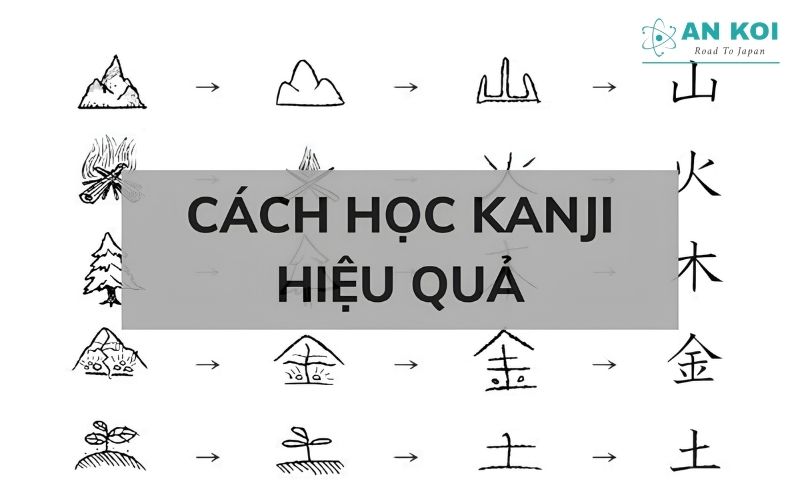
Effective ways to learn Kanji for beginners
Learn Japanese effectively with ANKOI – A crucial foundation for your study abroad journey in Japan.
If you want to learn Kanji systematically and conquer the JLPT in a short time, ANKOI provide a roadmap Japanese language training from N5 to N1Suitable for beginners, JLPT exam candidates, and those planning to study in Japan. The curriculum is designed with practical goals in mind, helping students build a solid language foundation and apply it effectively in their studies and daily lives.
Highlights of the course at ANKOI:
- Clear learning pathFrom N5 to N1, focusing on JLPT goals and studying abroad.
- Intensive courseFor beginners in Japanese, complete the N5 level in approximately 3 months.
- Practice Kanji using a scientific method.Combining radicals, vocabulary, and context helps with long-term memorization.
- Practice JLPT exam questions regularly: Assessing abilities and adjusting learning paths for each student.
- Experienced teaching staff, accompanying you throughout the learning and exam preparation process.
- Personalized roadmap consultationSuitable for those aiming to study abroad, take the JLPT exam, or work in Japan.

ANKOI – A reputable Japanese language training center
We hope this article has answered your question about how many Kanji characters there are in Japanese. You should now have a clearer understanding of the complete Kanji system, the number of Kanji required for each JLPT level, and how many Kanji are recommended for the JLPT N5. Rather than trying to learn every Kanji, build a study plan that matches your goals and prioritize commonly used characters to achieve the best results. If you need advice on learning Japanese or preparing for the JLPT, feel free to contact ANKOIfor personalized guidance and recommendations on the most suitable course for your needs.
>> See more:Reputable Study Abroad Consulting Services in Khanh Hoa – Detailed A-Z Pathway – An Koi
Latest Posts


Hashtags
Contact


