


16/08/2026
The Japanese Kanji alphabet is an important part of learning Japanese, but its large number of characters and multiple readings can easily feel overwhelming for beginners. Which Kanji should you know, how are they written and read, and how can you remember them for longer? This article will help you understand the 2,136 commonly used Kanji, how to analyze radicals, stroke-order rules, Onyomi and Kunyomi, and effective learning methods. You can also explore Kanji lookup tools, study apps, and an N5-to-N1 learning path with AN KOI.
What is the Japanese Kanji alphabet? 2,136 commonly used Kanji to know
The Japanese Kanji alphabet is a system of Chinese characters used in Japanese to express the meanings of words. Unlike Hiragana and Katakana, each Kanji usually carries its own meaning and may have several readings depending on the word in which it is used. Kanji commonly appears in vocabulary, proper names, books, newspapers, and everyday Japanese texts.
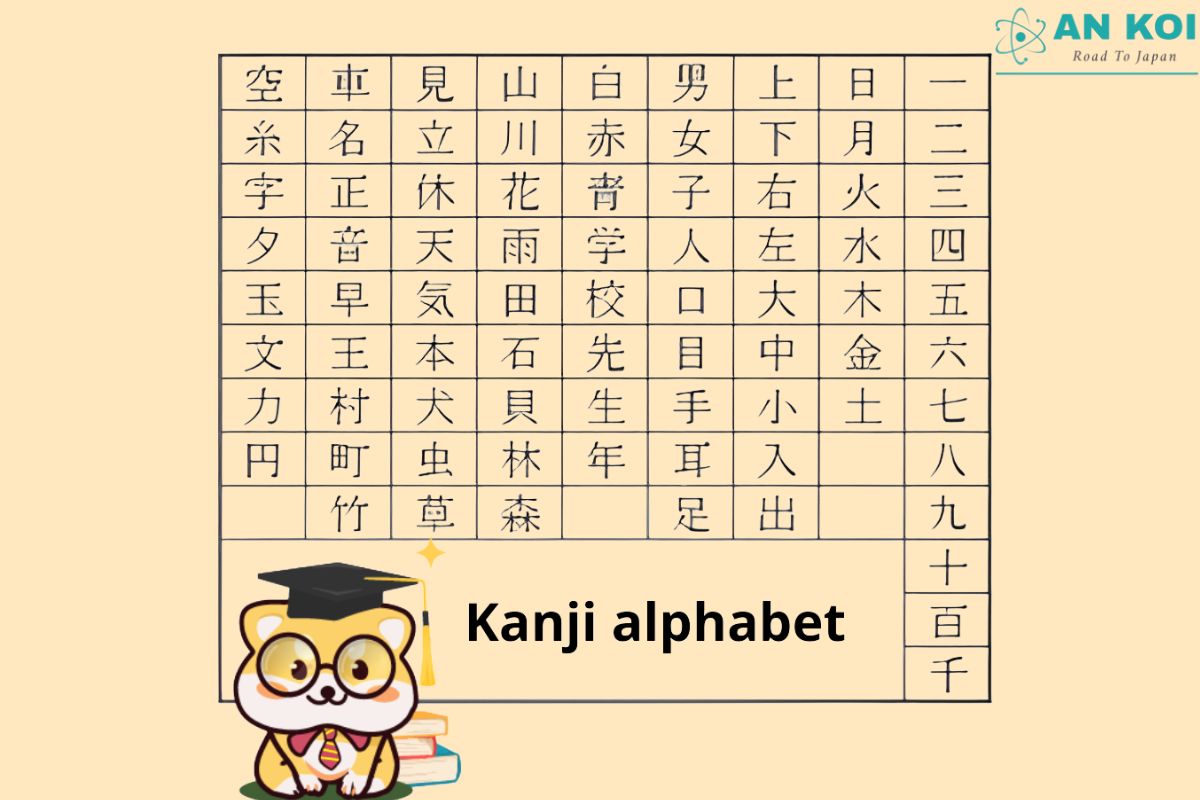
The Japanese Kanji alphabet is a system of Chinese characters with their own meanings and potentially multiple readings
Today, the Japanese Kanji system contains thousands of characters, of which 2,136 commonly used Kanji are widely used in everyday life and education in Japan. Beginners do not need to learn all of them at once and should start with basic characters. For easier study and review, you can use the resource below covering 2,136 commonly used Kanji, organized around the characters most frequently used in Japanese.
Download the 2,136 commonly used Kanji here
Kanji structure and how to remember character shapes
Understanding character structure makes the Japanese Kanji alphabet easier to learn. A Kanji can be formed from strokes, radicals, and several other components. Radicals often help identify or suggest meaning, while some components may provide clues to pronunciation. Understanding this structure allows learners to analyze unfamiliar characters instead of memorizing them mechanically.
Radicals help identify and remember Kanji
A radical (部首) is a component used to classify and look up Kanji, and some radicals can also suggest meaning. For example, 氵 is often related to water and appears in 海(うみ) – sea, 河(かわ) – river, and 洗(あらう) – to wash. When studying the Japanese Kanji system, prioritize radicals that appear frequently so you can build connections between characters.
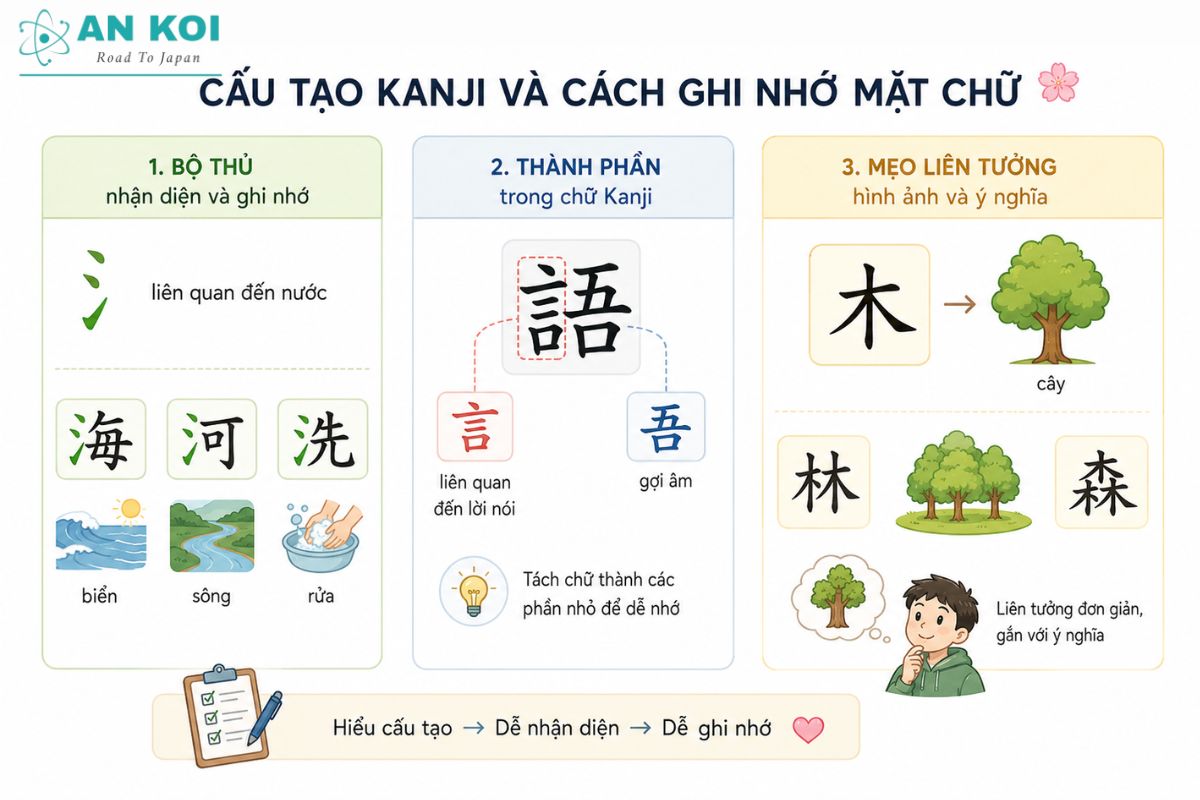
Radicals help identify and remember the meaning of each Kanji character in Japanese
Common components in Kanji characters
Besides radicals, Kanji can contain semantic components and phonetic components. For example, 語 consists of 言 and 吾; 言 relates to speech and helps learners recognize the character’s semantic group. When learning the Japanese writing system, breaking a character into smaller components makes it easier to identify and remember, especially with complex Kanji.
Tips for associating images with meanings
Visual association is an effective way to remember the Japanese Kanji alphabet. For example, 木 resembles a tree, so learners can directly associate its shape with the meaning ‘tree.’ You can also create your own images or short stories based on a character’s structure. With a Japanese Kanji chart, keep associations simple, memorable, and closely connected to meaning so you can recall characters quickly in real situations.
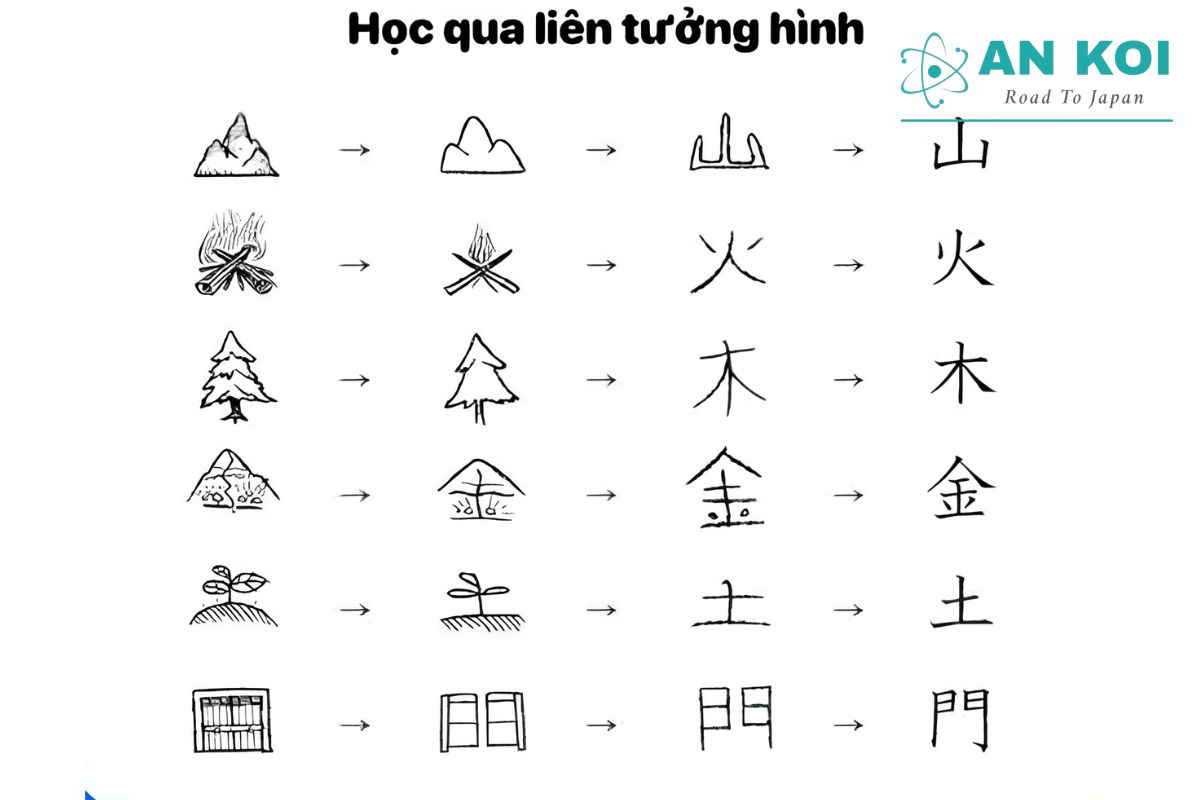
Using visual associations based on character shapes is an effective way for beginners to remember Kanji
How to write the Japanese Kanji alphabet with correct stroke order
Writing strokes in the correct order is an important foundation when learning the Japanese Kanji alphabet. Stroke order not only makes characters balanced and easier to read but also supports visual memory. Beginners should practice simple Kanji first before moving on to characters with more complex structures.
Rules for Kanji stroke order
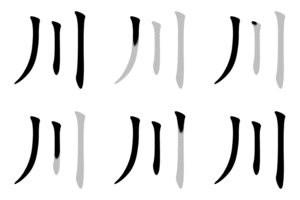
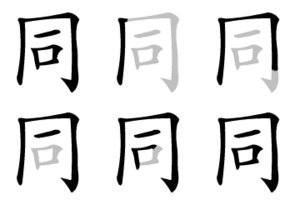
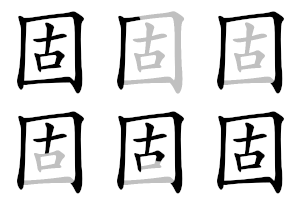
When learning the Japanese Kanji alphabet, understanding stroke order helps your writing become balanced, clear, and easier to remember. Beginners do not need to memorize the stroke order of every character immediately. Instead, learn the basic principles and apply them during practice. The table below summarizes seven common stroke-order rules to make correct Kanji writing easier to understand and remember.
|
7 basic rules for writing Kanji |
||||||
|
Horizontal → vertical |
Left-fall → right-fall |
Top → bottom |
Left → right |
Outside → inside |
Inside → close |
Center → sides |
 |
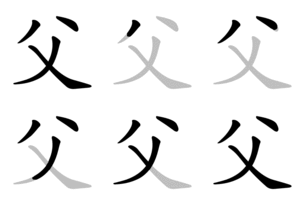 |
|
 |
 |
 |
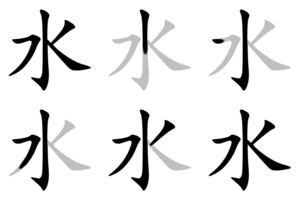 |

These principles are general guidelines, and some characters have exceptions. When practicing Japanese Kanji, if you encounter a difficult character, check its stroke order in a dictionary or an animated stroke-order tool rather than guessing.
Common basic strokes in Kanji
The Japanese Kanji alphabet is formed from many basic strokes. In Japanese, these strokes are collectively called 筆画 (ひっかく – hikkaku), meaning the strokes that make up a character. Recognizing each stroke type helps learners understand character structure instead of memorizing shapes alone. Common strokes include:
|
Stroke |
Japanese name |
Description |
Example |
|
一 |
横 (よこ) |
Horizontal stroke, written from left to right |
一 |
|
丨 |
縦 (たて) |
Vertical stroke, written from top to bottom |
十 |
|
丿 |
左払い (ひだりはらい) |
Left-falling stroke from upper right to lower left |
人 |
|
㇏ |
右払い (みぎはらい) |
Right-falling stroke from upper left to lower right |
大 |
|
丶 |
点 (てん) |
Dot stroke |
六 |
|
亅 |
はね |
Stroke ending with an upward hook |
小 |
|
𠃍 |
折れ (おれ) |
Stroke that changes direction without lifting the pen |
口 |
|
㇚ |
はね |
Stroke ending with a hooking motion |
小 |
Download Kanji writing practice sheets here
How to practice writing Kanji accurately and neatly
To practice Japanese Kanji effectively, beginners should work character by character rather than writing large groups at once. First, study the model character to identify the number of strokes, stroke order, structure, and position of each component. Then follow this sequence: trace the model, copy it into grid squares, hide the model, and write it from memory. This method gradually moves you from ‘looking and copying’ to writing the Japanese Kanji alphabet from memory.
You can use the following five-step process:
- Observe: Look at the model character, number of strokes, and stroke order before writing.
- Trace: Follow the provided strokes to become familiar with their direction and endpoints.
- Copy: Write the character about 5-10 times in grid squares, paying attention to size and proportions.
- Write from memory: Cover the model and write the character again to test recall.
- Compare: Check your writing against the model and mark errors in stroke order, angle, spacing, or component placement.
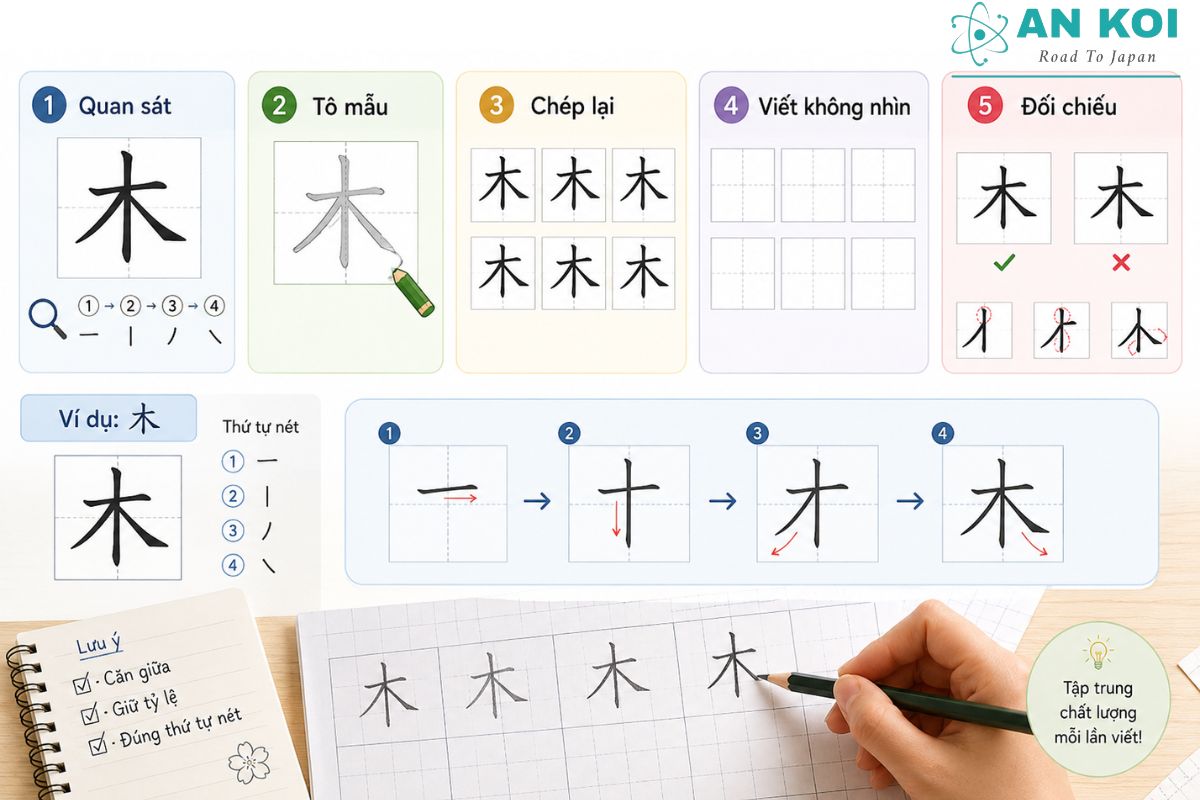
Practicing the Japanese Kanji alphabet on grid paper helps center characters and maintain balanced proportions
When practicing the Japanese Kanji alphabet, use grid paper with center guidelines to keep characters centered and proportionate. Beginners can start with larger squares and move to smaller ones once they have better control over their strokes.
For example, with 木, write 一 → 丨 → 丿 → ㇏, then copy it a few times, cover the model, and write it again from memory. If the character looks unbalanced, do not keep copying it dozens of times. Instead, identify exactly which stroke or component is incorrect and practice that part again. This keeps learning focused on the quality of each attempt rather than the quantity of repetitions.
>> See also:How many Kanji characters are there in Japanese? Latest 2026 update
How to read Kanji: Onyomi, Kunyomi, and special readings
One reason the Japanese Kanji alphabet can be difficult is that a single character may have multiple readings. The two most common are Onyomi and Kunyomi. There are also special readings that need to be learned word by word.
Differences between Onyomi and Kunyomi
|
Criterion |
Onyomi (音読み) |
Kunyomi (訓読み) |
|
Origin |
Derived from Chinese pronunciations introduced into Japan |
Native Japanese readings assigned to Kanji meanings |
|
Characteristics |
Closer to Sino-Japanese pronunciation; often used in Kanji compounds |
Usually associated with native Japanese words |
|
Typical use |
Common in Kanji compounds |
Often appears together with Hiragana |
|
Example: 山 |
さん (san) |
やま (yama) |
|
Example word |
火山(かざん)= volcano |
山(やま)= mountain |
|
How to learn |
Learn together with specific compound words |
Learn together with words and inflected forms of verbs and adjectives |
Example with 山:
- Onyomi: 山 → さん, as in 火山(かざん) – volcano.
- Kunyomi: 山 → やま, as in 山(やま) – mountain.
However, these are not absolute rules. Some words use only Onyomi, others use Kunyomi, and some Kanji have several possible readings. Therefore, when learning Japanese Kanji, it is best to remember the Kanji + reading + specific vocabulary word together instead of memorizing each reading in isolation.
Special cases in Kanji readings
After understanding Onyomi and Kunyomi, learners of the Japanese Kanji alphabet should pay attention to several special reading patterns. Some words use Onyomi even when a Kanji stands alone, while some compounds combine Kunyomi and Onyomi.
- A single Kanji read with Onyomi: Some characters still use a Sino-Japanese reading when they stand alone. For example, 駅(えき) means ‘station,’ and 席(せき) means ‘seat.’
- Kanji + Kanji both read with Kunyomi: Some compounds use native Japanese readings for both characters. For example, 手紙(てがみ) means ‘letter,’ and 青空(あおぞら) means ‘blue sky.’
- Kanji + Kanji combining Kunyomi and Onyomi: Some compounds mix the two reading types in the same word. For example, 荷物(にもつ) means ‘luggage/belongings,’ where 荷 is read with the Kunyomi に and 物 with the Onyomi もつ; 場所(ばしょ) means ‘place,’ where 場 is read as ば and 所 as しょ.
Therefore, when learning the Japanese Kanji alphabet, avoid rigidly applying rules such as ‘Kanji compounds always use Onyomi’ or ‘a standalone Kanji always uses Kunyomi.’ A more effective approach is to learn each Kanji together with real vocabulary and actual readings, especially words that frequently appear in conversation and on the JLPT.
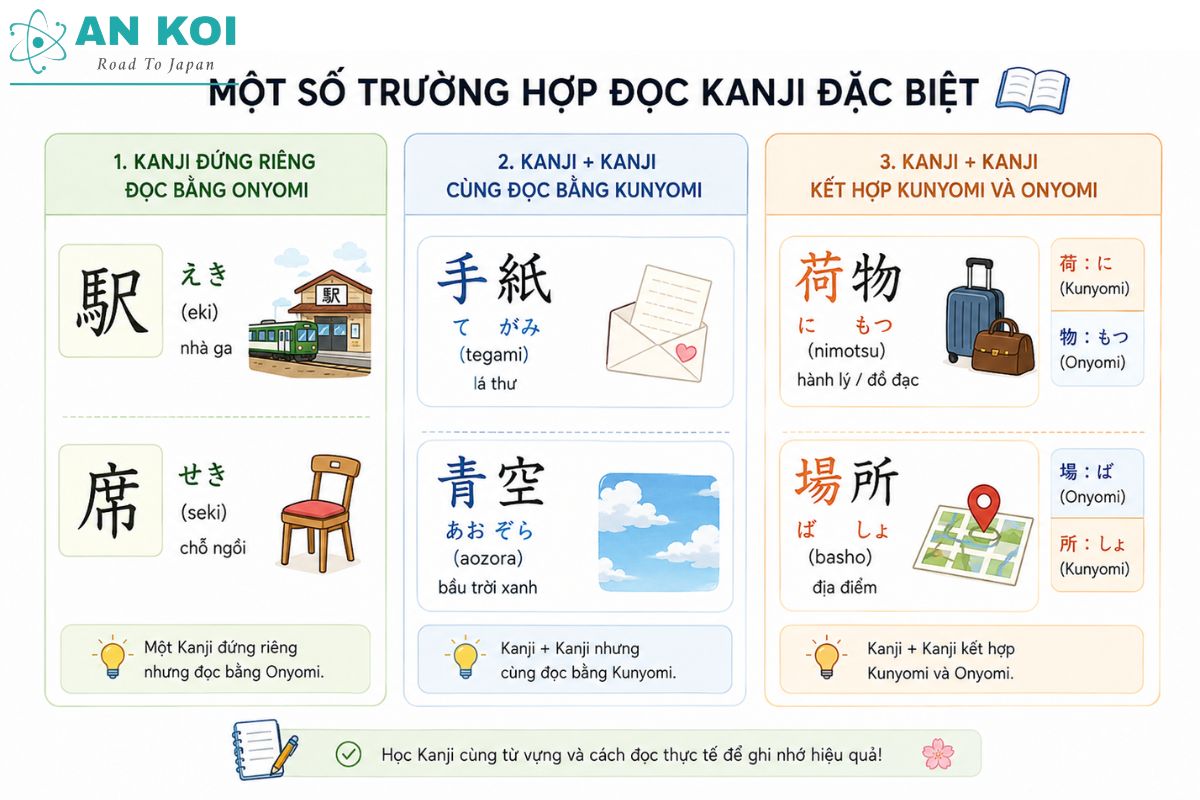
Some special Kanji readings combine both Onyomi and Kunyomi within the same compound word
How to learn the Japanese Kanji alphabet effectively
There is no single method that works for every learner. However, an effective approach to the Japanese Kanji alphabet usually combines character recognition, understanding meaning, practicing readings and writing, and using Kanji in context.
1. Learn by radicals and related character groups
Learning by radicals helps you recognize recurring components in Japanese Kanji. For example, 氵 is often associated with water and appears in 海(うみ) – sea, 池(いけ) – pond, and 洗(あらう) – to wash. With the Japanese Kanji alphabet, start with common radicals and gradually expand to related groups of characters.
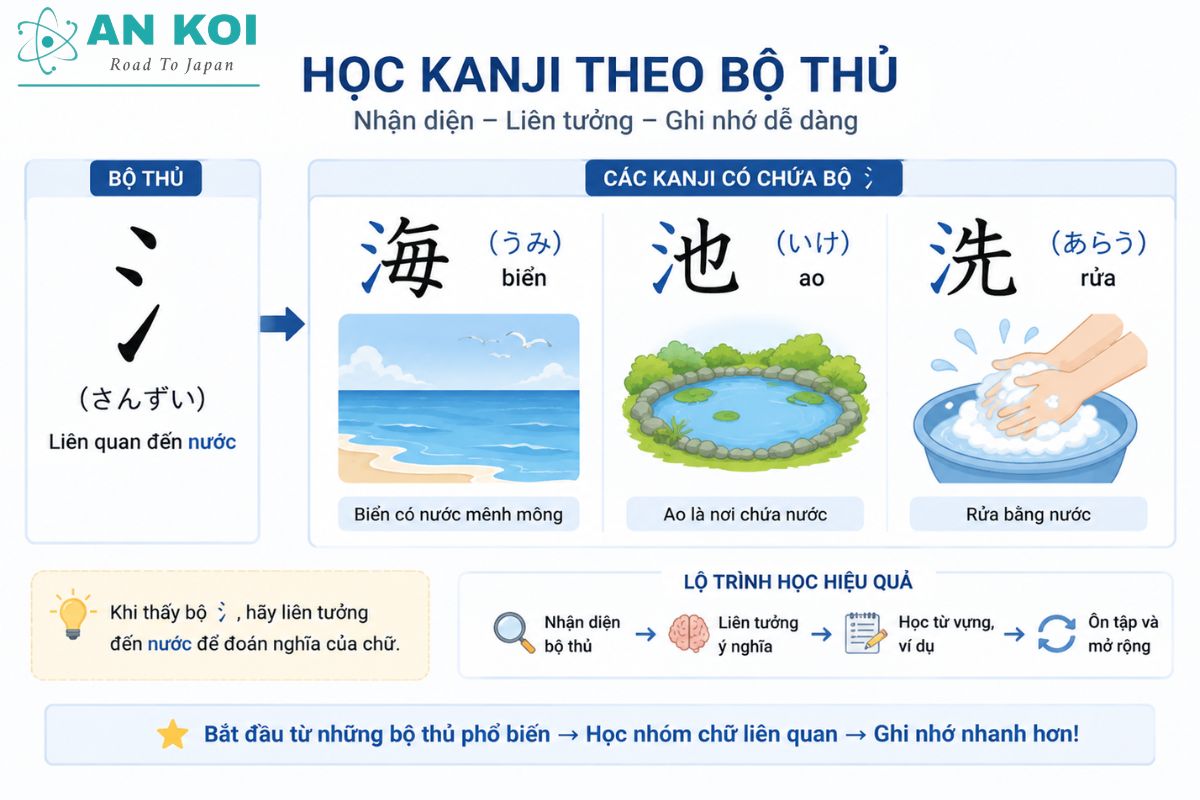
Learning Kanji by radicals helps identify recurring components across related character groups
2. Learn Kanji with vocabulary instead of isolated characters
Instead of memorizing only 食 = eat, learn it through words such as 食べる(たべる) – to eat, 食事(しょくじ) – meal, and 食堂(しょくどう) – cafeteria. This connects the Japanese Kanji alphabet with real contexts. For N5 Kanji, it is also an effective way to learn characters while expanding vocabulary.
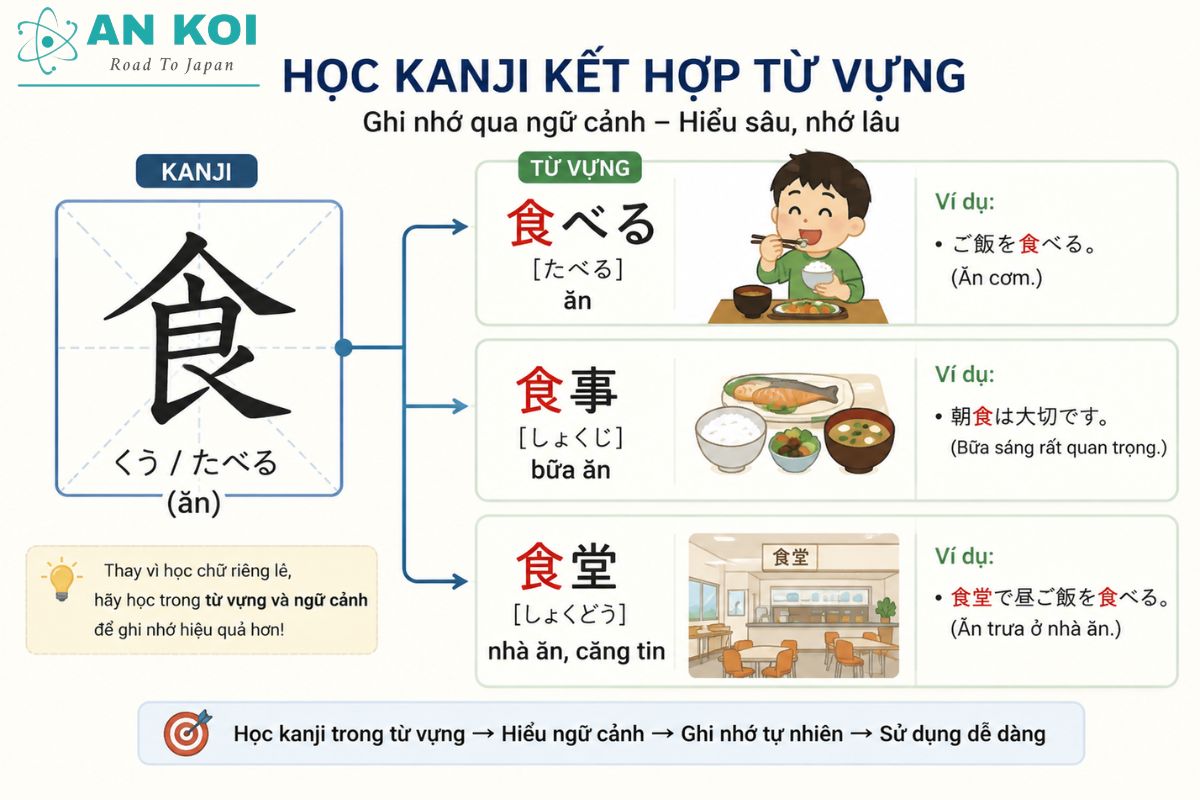
Learning Kanji with vocabulary instead of isolated characters helps connect memory to real contexts
3. Review Kanji with flashcards and Spaced Repetition
Flashcards combined with Spaced Repetition help you review Kanji just before you are likely to forget them. Each card should include the character, reading, meaning, and an example word. When reviewing Japanese Kanji, try to recall the answer before checking it to strengthen active memory.
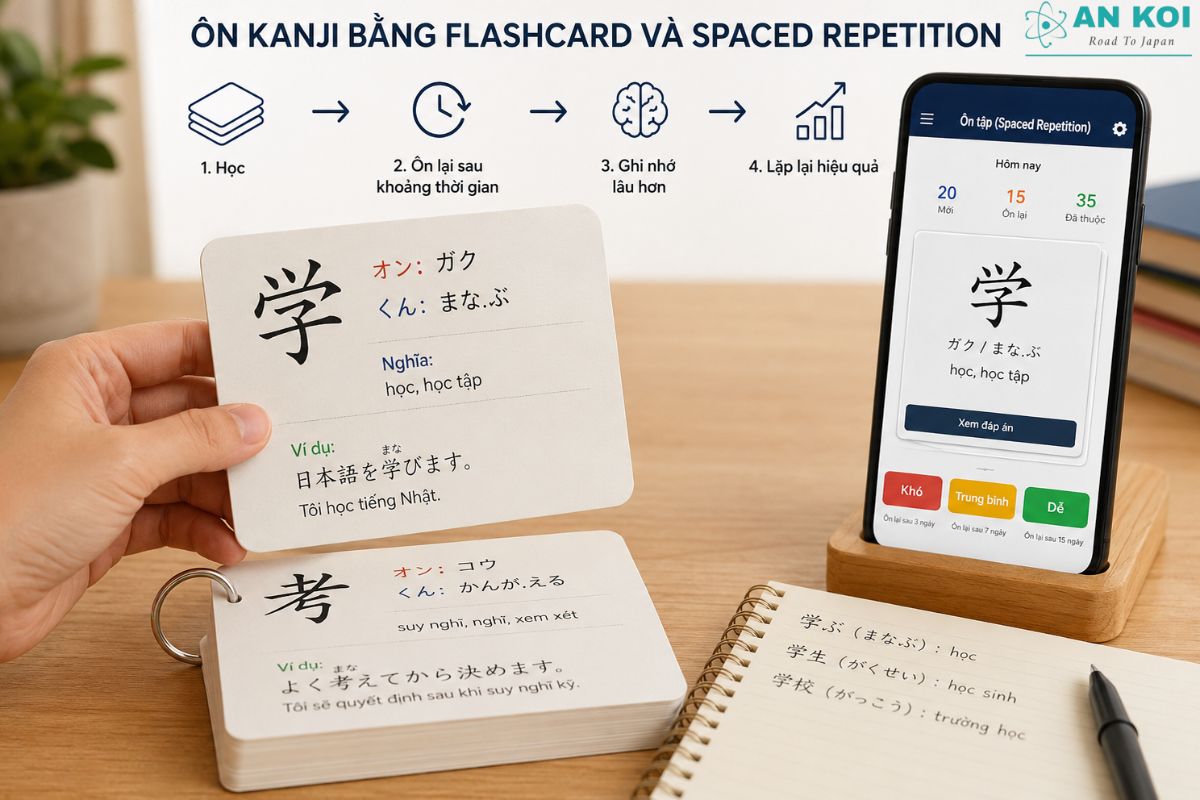
Flashcards combined with Spaced Repetition help review Kanji at the right time before they are forgotten
4. Practice reading through Japanese sentences and texts
Putting Kanji into sentences helps learners remember readings and usage more naturally. After studying the Japanese Kanji alphabet, you can begin with short sentences, simple stories, or materials suited to your level. This allows Japanese Kanji to be remembered through context rather than rote memorization.
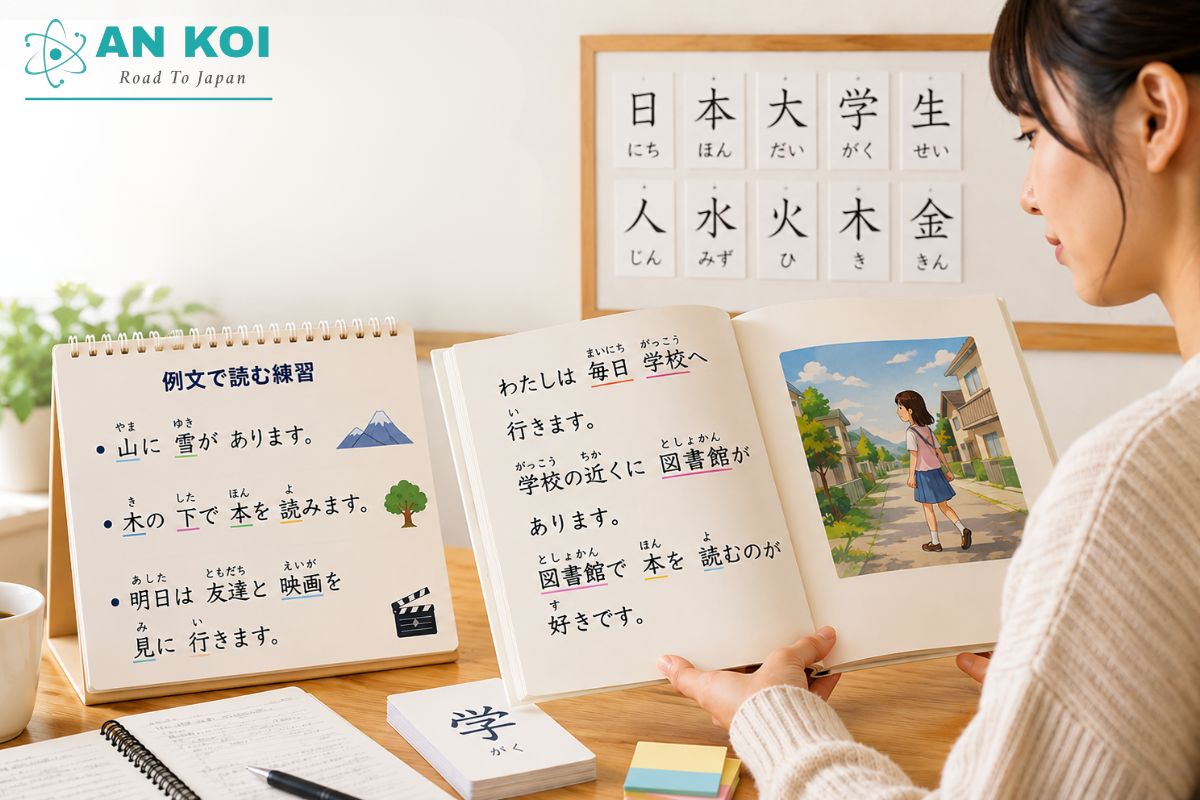
Practicing the Japanese Kanji alphabet through sentences and texts helps build more natural recall
>> See also:How long does it take to learn Japanese N5? A standard 2-3 month roadmap
Common mistakes when learning Kanji
Learning Japanese Kanji can quickly become overwhelming without the right strategy. Beginners often focus on the number of characters while overlooking the ability to use them in practice. Recognizing the mistakes below early can help you adjust your study method.
- Learning too many characters at once: Taking in a large amount of Kanji in one day can cause the information to be forgotten quickly.
- Remembering the shape but forgetting the reading: Recognizing a Kanji does not necessarily mean you can read and use the word correctly.
- Ignoring stroke order when practicing writing: Repeatedly writing characters in the wrong order can create habits that become difficult to correct at higher levels.
With the Japanese Kanji alphabet, steady progress matters more than completing a large number of characters in a short time.
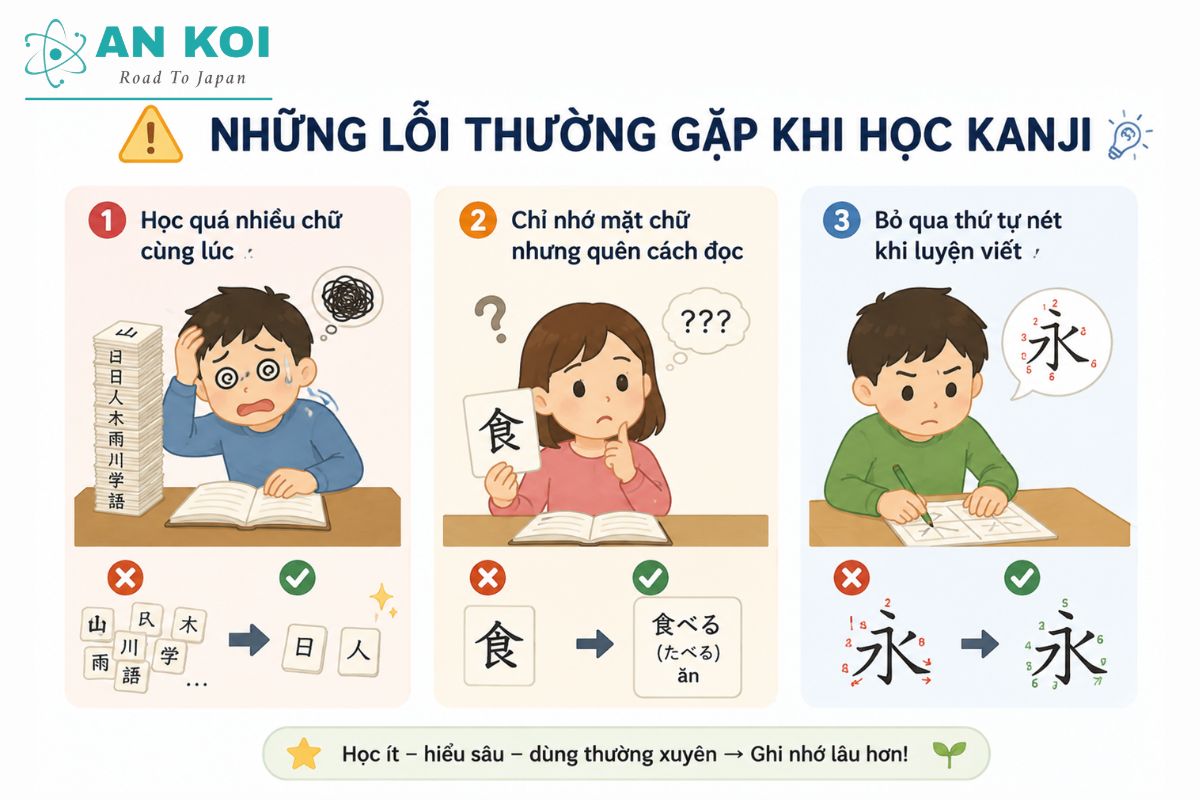
Learning too many characters at once or ignoring stroke order are common mistakes when studying Kanji
Tools for looking up and learning Kanji faster
Digital tools can provide significant support when learning the Japanese Kanji alphabet, especially for checking readings, stroke order, and usage examples. However, tools should support active practice rather than replace it.
Kanji learning apps for different levels
Beginners learning the Japanese Kanji alphabet can choose apps based on their goals rather than installing too many tools at once. Useful options include:
- WaniKani: Suitable for beginners to intermediate learners, focusing on Kanji and vocabulary through radicals, mnemonics, and Spaced Repetition.
- Anki: Suitable for learners who want to build their own flashcard decks and control the content, review method, and repetition intervals.
- Kanji Study: Useful for learners who want to practice recognition, look up characters, and handwrite Kanji, especially on Android.
- Renshuu: Suitable for learners who want to combine Kanji with vocabulary, grammar, and other Japanese practice activities.
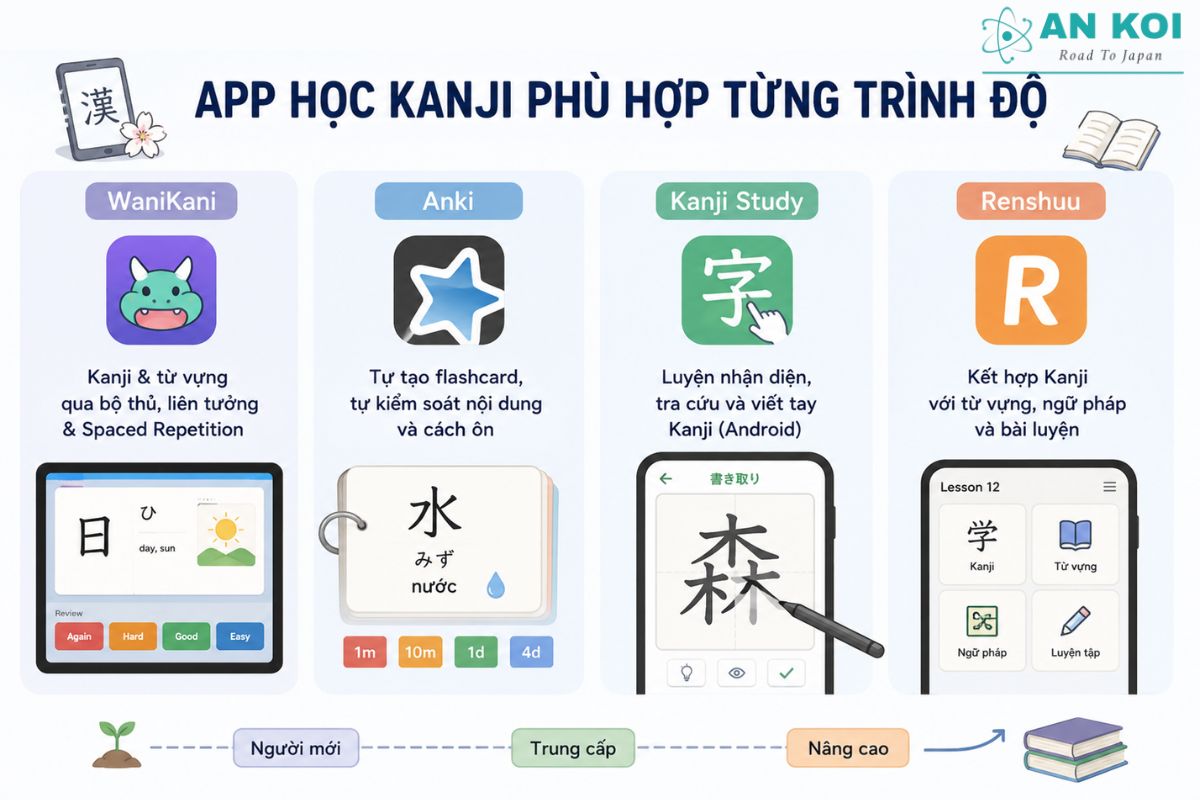
Apps such as WaniKani, Anki, and Kanji Study support Kanji practice at different proficiency levels
For Japanese Kanji study, beginners can start with WaniKani or Renshuu for a structured path. If you want to build your own review system, Anki offers greater flexibility.
Dictionaries and websites for looking up Kanji
When you encounter a new character in the Japanese Kanji alphabet, lookup websites can quickly show its meaning, readings, radical, and stroke order. Useful tools include:
- Kanji alive: Lets you search Kanji by character, Onyomi, Kunyomi, English meaning, radical, stroke count, and level, while also providing stroke-order information.
- Jisho: Useful for looking up Kanji, vocabulary, and readings in many Japanese-learning situations.
- Kakijun: Helpful when you need to check the stroke order and writing method for individual Kanji.
- NHK Easy Japanese: Can be used to place learned Kanji into real reading contexts, especially once your level is high enough for simple content.
For N5 Kanji, prioritize tools that show both readings and vocabulary examples. This way, you not only know what a Kanji means but also understand how it is used in a sentence.
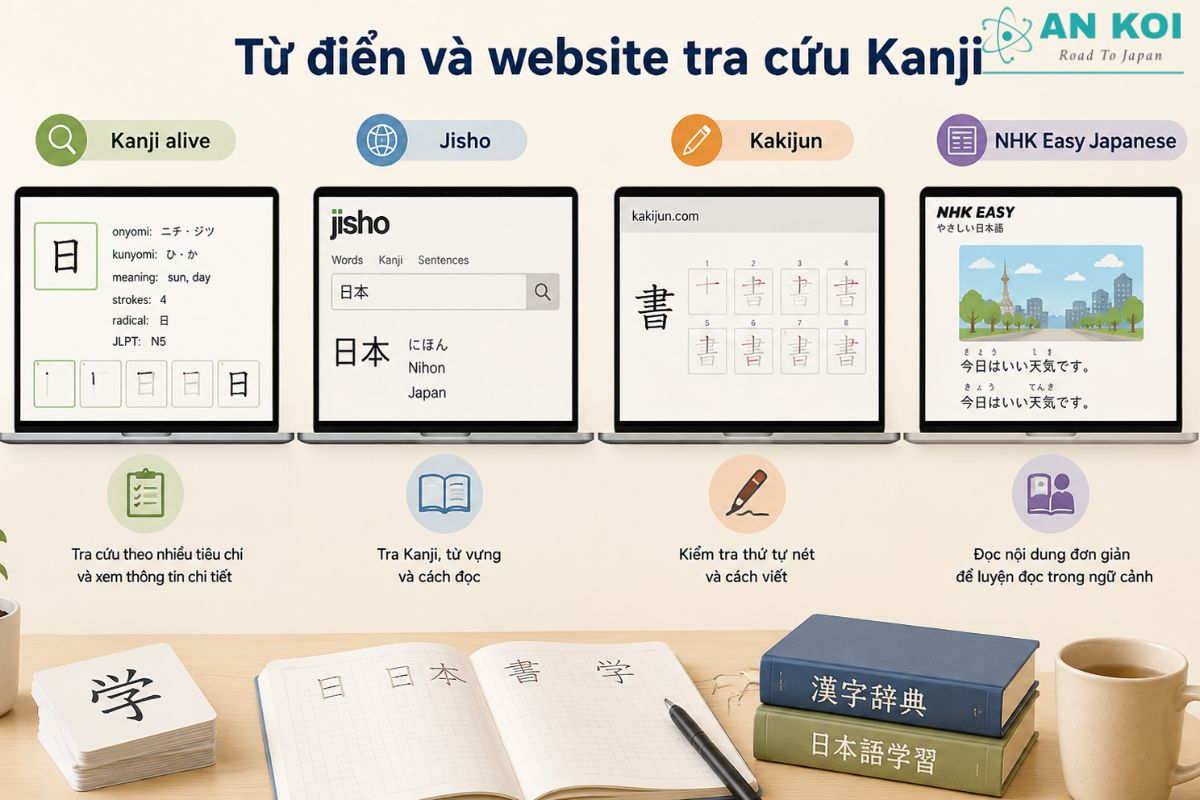
Dictionaries and lookup websites help you quickly check Kanji meanings, readings, and stroke order
How to use a Kanji chart for self-review
Instead of treating a Japanese Kanji chart as a simple list, turn it into a study tracker. You can create columns for Kanji – meaning – Onyomi – Kunyomi – vocabulary – review date – memory level.
For example, when learning 学, add 学生(がくせい)- student and 学校(がっこう)- school instead of writing only the meaning ‘study.’ At the end of each week, randomly select characters you have learned and test yourself by reading, writing, and making sentences. With the Japanese Kanji alphabet, this review method checks recognition, reading, and practical use rather than character shape alone.
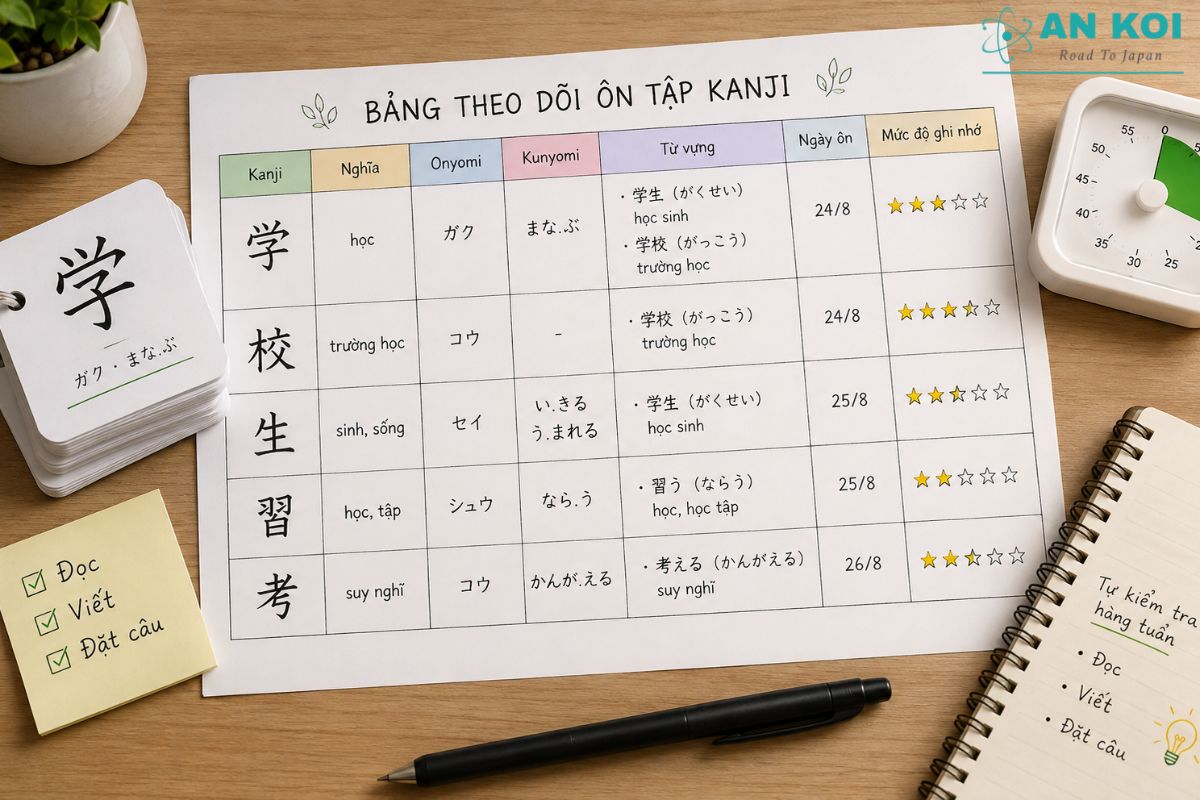
Use the Japanese Kanji alphabet as a self-review tracker with columns for meanings, readings, and vocabulary
Master Kanji and Japanese with AN KOI
Mastering the Japanese Kanji alphabet requires an appropriate method and a clear study path. Instead of memorizing Kanji as isolated items, AN KOI guides learners to combine Kanji with vocabulary, grammar, and practical Japanese skills at each level.
If you are looking for a structured Japanese-learning environment, AN KOI offers several advantages worth considering:
- A clear N5-N1 roadmap: The program is divided by proficiency level, helping learners set goals and progress step by step.
- A systematic learning method: Kanji is studied together with vocabulary, grammar, and practical Japanese-language skills.
- JLPT preparation guidance: Course content follows each proficiency level and suits learners aiming for Japanese-language certification.
- Regular proficiency assessment: Learners can identify strengths and weaknesses and adjust their review strategy accordingly.
- Suitable for study-abroad goals in Japan: In addition to Japanese-language training, the program also supports learners preparing for study in Japan.
- Support from the fundamentals: Beginners can start with foundational knowledge and gradually build stronger Japanese proficiency.

AN KOI supports learners in mastering Kanji through a clear N5-N1 roadmap
If your goal is to master the Japanese Kanji alphabet for the JLPT, communication, or studying abroad, having the right roadmap from the beginning can save significant time otherwise spent searching for materials and correcting mistakes. Instead of learning Kanji in isolation, you can start from your current level and progress toward N5-N1 with AN KOI’s Japanese language training program.
Latest Posts


Hashtags
Contact


