


22/07/2026
In Japanese, choosing the right way to express yourself is just as important as using correct vocabulary and grammar. In particular, Japanese Honorific Language helps speakers show respect toward superiors, customers, business partners, and elderly people. However, because the honorific system includes various verb forms, grammatical rules, and exceptions, learners often find it confusing. This guide from ANKOI explains everything from the basic concept and verb conjugation to real-life situations, helping you use Japanese Honorific Language accurately and naturally.

What is honorific language in Japanese? How to use it correctly from A to Z.
What are Japanese honorific language?
Japanese Honorific Language (Sonkeigo, 尊敬語) is one of the honorific speech styles used to express respect for the actions, conditions, or words of someone who has a higher social status, is older, or holds a higher position than the speaker. It is an essential part of the Japanese honorific system and reflects Japan’s culture of courtesy and respect.
Unlike ordinary speech, Japanese Honorific Language elevates the status of the other person rather than the speaker. Learners need to understand its purpose clearly in order to avoid using it incorrectly in real-life conversations. Mastering Japanese Honorific Language not only helps you achieve better results in Japanese language proficiency exams but also creates a professional impression when working for Japanese companies or communicating with native speakers.
When should you use Japanese honorific language?
The use of Japanese Honorific Language depends on the person you are speaking about and the specific situation. In most cases, you should use Japanese Honorific Language when referring to the actions of your supervisor, teacher, customer, elderly person, or anyone who deserves respect.
Some common situations include:
- Communicating with your manager or supervisor at work.
- Welcoming customers or business partners.
- Speaking with teachers or professors.
- Talking to elderly people or individuals in positions of authority.
- Writing business emails in Japanese.
For example, instead of using the ordinary verb 「言います」 (to say), Japanese speakers use 「おっしゃいます」 to show respect toward the person being referred to. Understanding when to use Japanese Honorific Language correctly allows it to convey its intended meaning while making conversations more polite and natural.
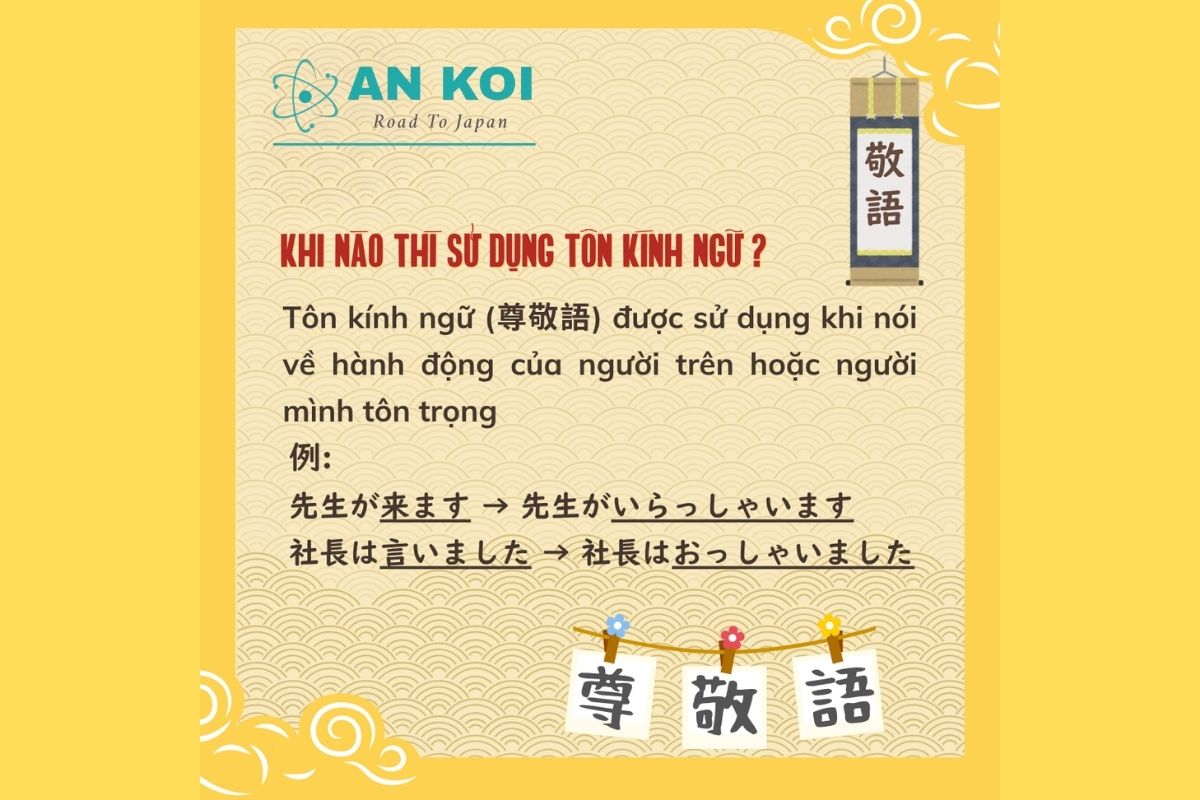
When should you use Japanese honorific language?
The role of honorifics in communication
Japanese Honorific Language is more than just a grammar point. It represents one of the defining characteristics of Japanese communication and etiquette. Using honorific language correctly enables speakers to demonstrate professionalism, courtesy, and respect in a wide variety of situations.
In business environments, employees commonly use Japanese Honorific Language when communicating with customers or supervisors to build a trustworthy and professional image. For international students and foreign workers in Japan, it is also an essential skill that helps them adapt more quickly to academic and workplace environments.
In addition, using Japanese Honorific Language correctly helps prevent misunderstandings or negative impressions caused by inappropriate expressions. This is one of the reasons why many Japanese language training programs and JLPT examinations include questions that assess learners’ ability to use honorific language appropriately in different real-life contexts.
Common forms of Japanese honorific language
To master Japanese Honorific Language, you first need to understand the most common honorific expressions used in daily communication. Honorific forms are not limited to verbs. Many nouns, adjectives, and adverbs also have honorific forms that express respect toward the listener or the person being referred to. Below are the three main categories of Japanese Honorific Language that every learner should prioritize.
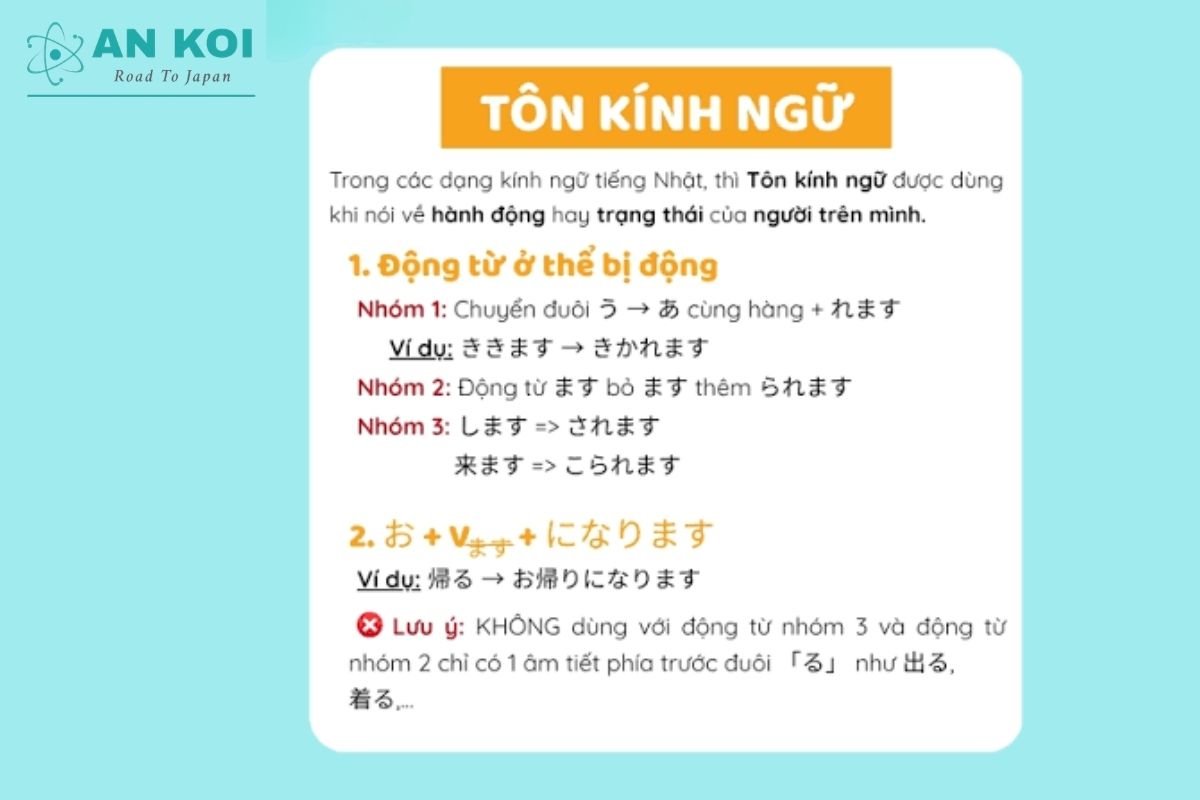
Common forms of Japanese honorific language
1. Honorific forms of nouns
Not all Japanese nouns remain unchanged in formal communication. In Japanese Honorific Language, many nouns are preceded by the honorific prefixes 「お」 or 「ご」 to express respect toward the person you are speaking to.
Some common examples:
|
Standard Noun |
Honorific Form |
|
名前 (name) |
お名前 |
|
国 (country) |
お国 |
|
家族 (family) |
ご家族 |
|
住所 (address) |
ご住所 |
|
意見 (opinion) |
ご意見 |
However, not every noun follows a fixed rule for adding 「お」 or 「ご」. Some words have established honorific forms that must be learned through examples and real conversations. Using honorific nouns correctly in Japanese Honorific Language makes your speech more polite and closer to the way native Japanese speakers naturally communicate.
2. Honorific forms of adjectives and adverbs
In addition to nouns, many adjectives and adverbs also have polite forms in Japanese Honorific Language. These expressions are commonly heard in restaurants, hotels, retail stores, and customer service situations.
Examples:
- 忙しい → お忙しい (busy)
- 元気 → お元気 (well / healthy)
- 暇 → お暇 (free / available)
- 少し → 少々 (a little)
- 今 → ただ今 (right now)
These expressions appear frequently in everyday communication. When studying Japanese Honorific Language, you should practice them in complete sentences rather than memorizing individual words. Learning through context helps you understand when each expression should be used and prevents incorrect usage in everyday conversations.
3. Honorific forms of verbs
Verbs are the most important part of Japanese Honorific Language because they express respect toward another person’s actions. In Japanese, honorific verbs generally fall into three categories:
- Verbs with special honorific forms.
- Verbs that follow regular honorific conjugation rules.
- Verbs expressed in the respectful passive form.
Examples:
|
Standard Verb |
Honorific Form |
|
見る |
ご覧になる |
|
行く・来る |
いらっしゃる |
|
食べる |
召し上がる |
|
言う |
おっしゃる |
|
知っている |
ご存じだ |
When learning Japanese Honorific Language, you should prioritize memorizing these special honorific verbs because they appear frequently in JLPT examinations and workplace communication in Japan.
How to conjugate verbs into Japanese honorific language.
To use Japanese Honorific Language correctly, learners must understand how verbs are transformed into honorific forms. Most verbs follow three basic conjugation patterns, while some have unique honorific forms that must be memorized. Once you understand these patterns, you will be able to apply Japanese Honorific Language more confidently in both daily communication and JLPT examinations.
Rule 1: Use the passive voice (尊敬の受身)
Some verbs can be changed topassive voiceTo express respect (not in a passive voice).
For example:
- 読む → 読まれます
- 行く → 行かれます
- 来る → 来られます
- 話す → 話されます
Note: Be careful to distinguish this respectful passive form from the ordinary passive voice by considering the context.
Quy tắc 2: お + gốc động từ + になる
This pattern is commonly used with many Group I and Group II verbs.
Recipe:
お + verb stem (without ます) + になります
For example:
- 読みます → お読みになります
- 書きます → お書きになります
- 待ちます → お待ちになります
- 帰ります → お帰りになります
Rule 3: Verbs have their own honorific forms.
Some verbs do not follow the rules above and instead have unique honorific forms that must be memorized.
|
Standard Verb |
Honorific Form |
|
行く・来る |
いらっしゃる |
|
見る |
ご覧になる |
|
言う |
おっしゃる |
|
食べる・飲む |
召し上がる |
|
知る |
ご存じだ |
|
する |
なさる |
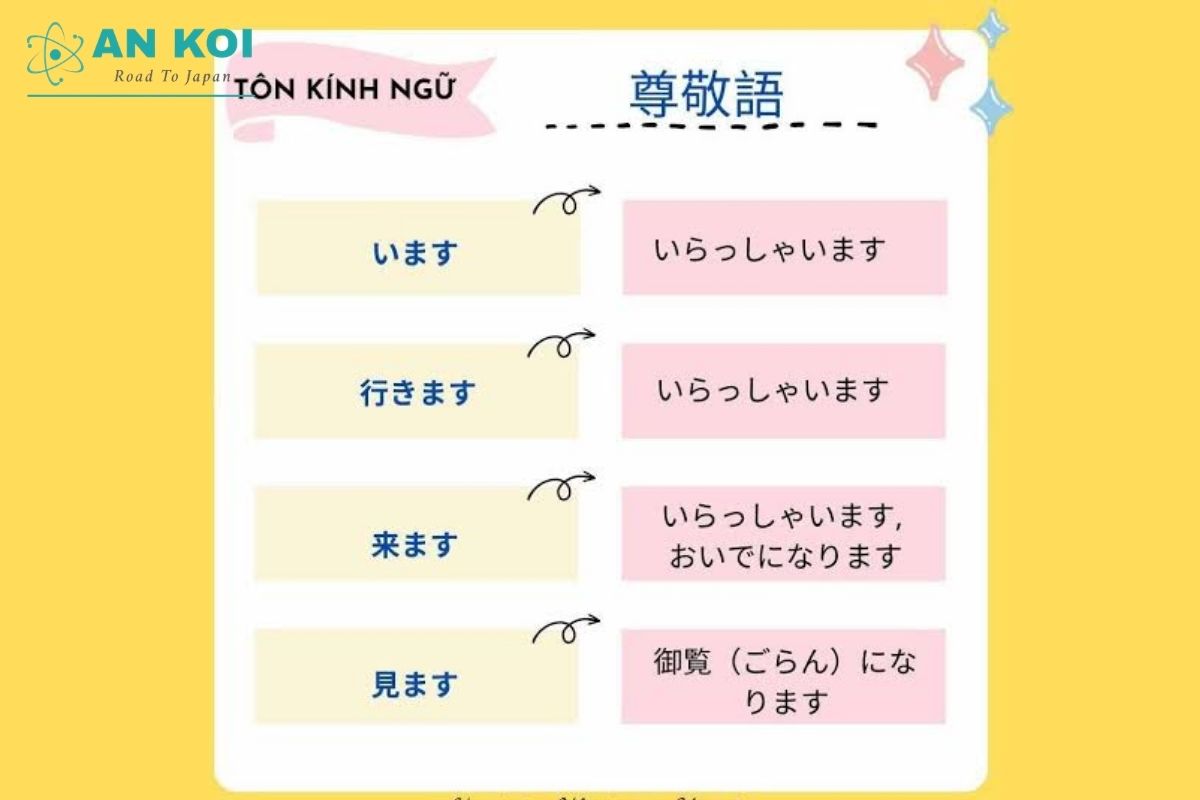
Japanese verb conjugations into honorifics
Common mistakes when using Japanese honorific language
While learning Japanese Honorific Language, many learners are able to memorize sentence patterns but still make mistakes when applying them in real-life situations. The main reason is a lack of understanding of the underlying rules or confusion between different honorific forms. Below are some of the most common mistakes to avoid.
- Using honorific language for the wrong person: Honorific language should only be used when referring to someone who deserves respect, such as a supervisor, customer, or teacher. It should not be used when talking about yourself or members of your own organization while communicating with people outside the organization.
- Overusing honorific language: Not every situation requires Japanese Honorific Language. When speaking with friends, family members, or colleagues of equal status, choosing a more appropriate level of politeness will make the conversation sound more natural.
- Confusing verb conjugation patterns: Not every verb follows the お + verb stem + になります pattern. Some verbs have special honorific forms, such as:
|
Standard Verb |
Honorific Form |
|
行きます・来ます |
いらっしゃいます |
|
見ます |
ご覧になります |
|
言います |
おっしゃいます |
|
食べます・飲みます |
召し上がります |
To use Japanese Honorific Language accurately, you should study these special verbs separately, understand who should receive respect in each situation, and practice through realistic communication scenarios rather than relying solely on grammar formulas. This approach will help you respond more naturally while studying, working, or living in Japan.
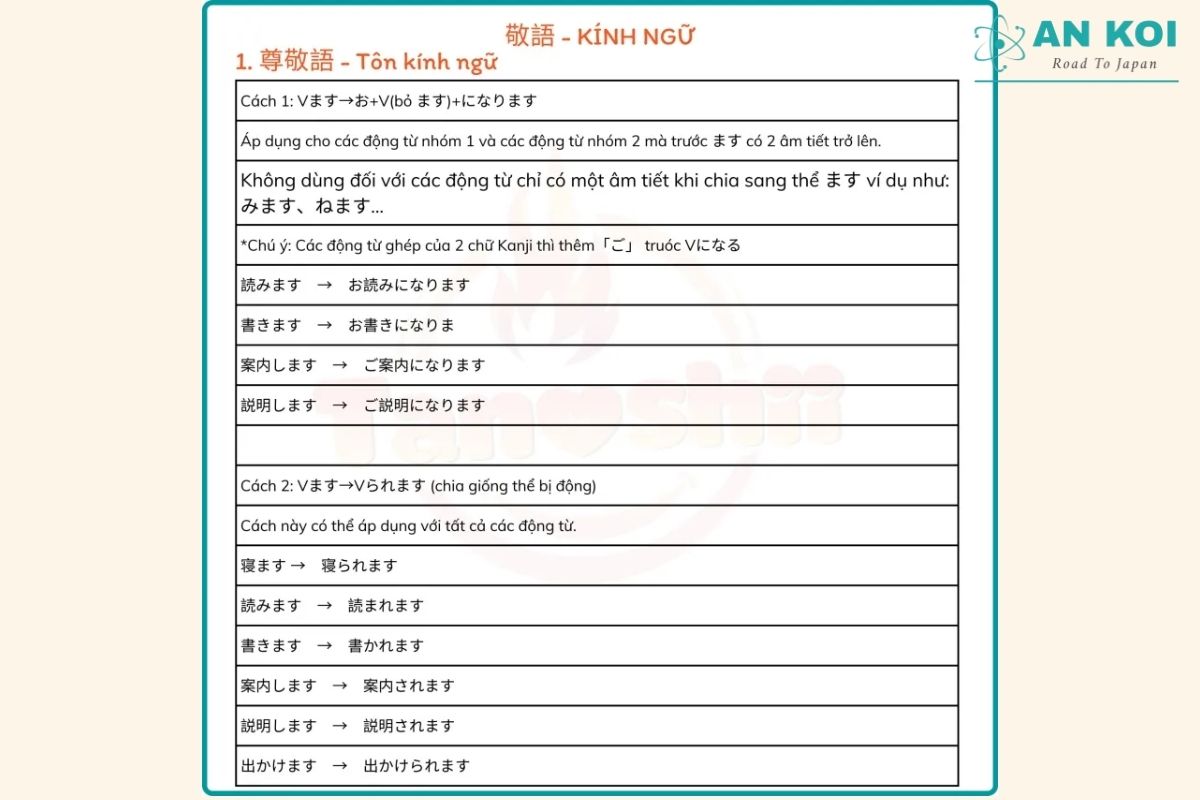
Common mistakes when using Japanese honorific language
Tips for memorizing Japanese honorific language effectively
Many learners consider Japanese Honorific Language difficult because it includes numerous sentence patterns and special verbs. However, with the right learning methods, you can memorize it more quickly and use it naturally in conversation. Instead of relying on rote memorization, combine contextual learning with consistent practice.
- Study verbs by category: Group verbs into special honorific verbs, verbs that follow the お + Vます + になります pattern, respectful passive forms, and verbs commonly used in business settings. This method makes it easier to recognize patterns and review efficiently.
- Learn through real-life conversations: Practice situations such as serving customers, working at hotel reception desks, assisting shoppers, or making business phone calls. Pay attention to who is speaking and who deserves respect so that you can understand how Japanese Honorific Language is used in context.
- Practice with the Shadowing method: Listen to conversations that include Japanese Honorific Language, then immediately repeat what the speaker says. Practicing for 15–20 minutes each day can significantly improve your pronunciation, intonation, and conversational reflexes.
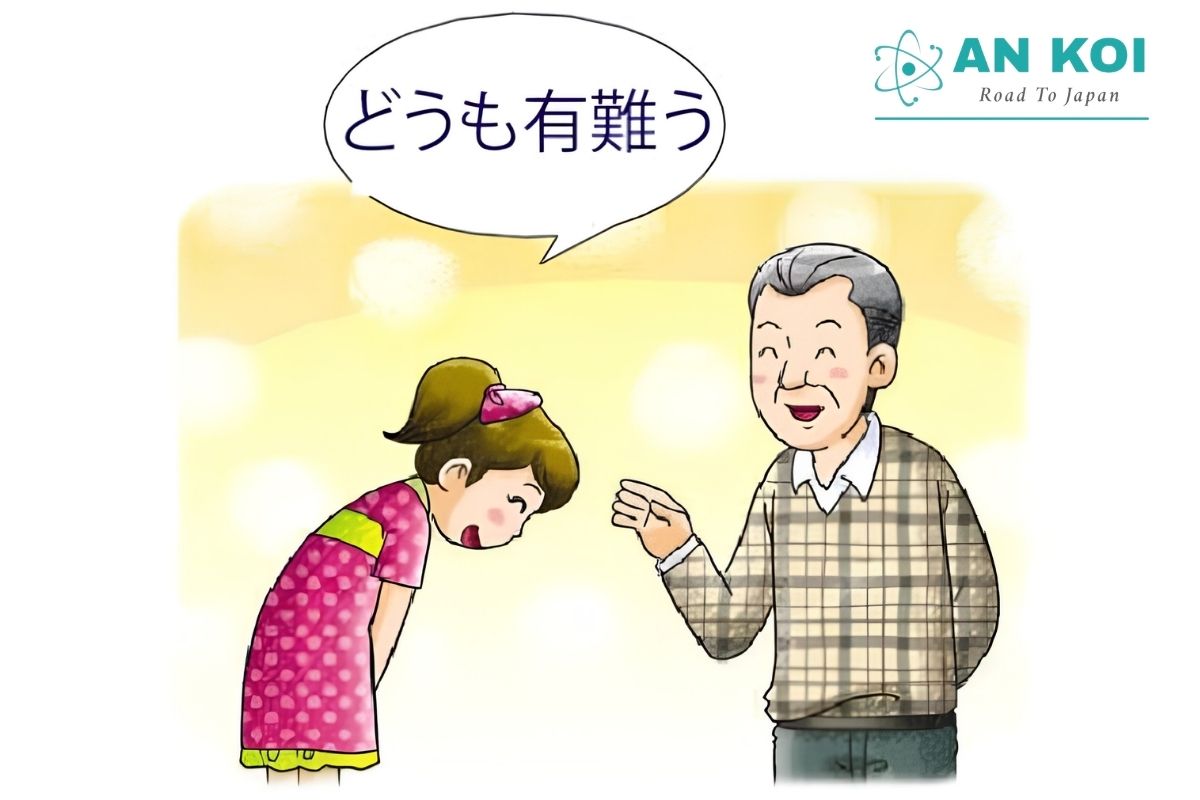
Memory techniques to learn Japanese honorific language faster
ANKOI – A leading and reputable Japanese language training center.
To master Japanese Honorific Language, learners need structured guidance and regular opportunities to practice in real communication settings. At ANKOI, Japanese language courses are designed with a step-by-step curriculum from N5 to N1, helping students build a strong foundation in grammar, vocabulary, and communication skills from the very beginning.
Japanese language training services at ANKOI include:
- Japanese courses from N5 to N1 for beginners and advanced learners.
- JLPT preparation courses tailored to each student’s goals and the official exam format.
- Japanese conversation courses with a strong focus on speaking practice and the practical use of honorific language in academic and workplace environments.
- Japanese language courses for international students and individuals preparing to work in Japan.
- Experienced instructors who closely monitor students’ progress and provide continuous support throughout the course.
- Personalized study plans designed to help learners optimize their study time and achieve better results.

ANKOI – A reputable Japanese language training center.
If you are looking for a reliable Japanese language center to study from beginner to advanced levels, prepare for the JLPT, or get ready for studying and working in Japan, ANKOI is here to help you gain confidence in using Japanese, including Japanese Honorific Language, in every communication situation.
>> See more:Reputable Study Abroad Consulting Services in Khanh Hoa – Detailed A-Z Pathway – An Koi
Latest Posts


Hashtags
Contact


